 Skip to content

To unblock an outside drain, lift the nearest inspection chamber cover, work out which length of pipe is holding water, then clear that section with drain rods turned clockwise and flush it through with a hose. Most domestic blockages sit within a few metres of a chamber and shift with rodding.
The step people skip is the diagnosis. Rodding the wrong chamber churns up sewage and tells you nothing about where the problem actually sits.
This guide covers the kit, how to find the blocked section, the clearing steps in order, the mistakes that make things worse, and who owns the pipe once the trouble moves past your boundary.
What You Need Before You Start Clearing an Outside Drain
Drain rods, heavy-duty gloves and a cover lifting key handle most outside drain blockages, with a garden hose for the flush afterwards. Rods matter most because they flex around bends in the pipe, which a garden cane or a length of hose cannot do.
- Drain rods with a plunger head, plus a corkscrew or worm head for compacted debris
- Heavy-duty rubber gloves and eye protection
- A manhole lifting key, or a strong flat bar if the cover has no keyholes
- A garden hose with reasonable pressure
- A bucket or scoop to lower the water level in a full chamber
- Wellingtons and clothes you can hose down afterwards
Wastewater carries bacteria, so cover any cuts and wash properly once you are finished. Chamber covers are heavy and older concrete ones crack easily. Lift with two people where you can, and keep children and pets well back from an open chamber.
How to Find Which Section of Drain Is Blocked
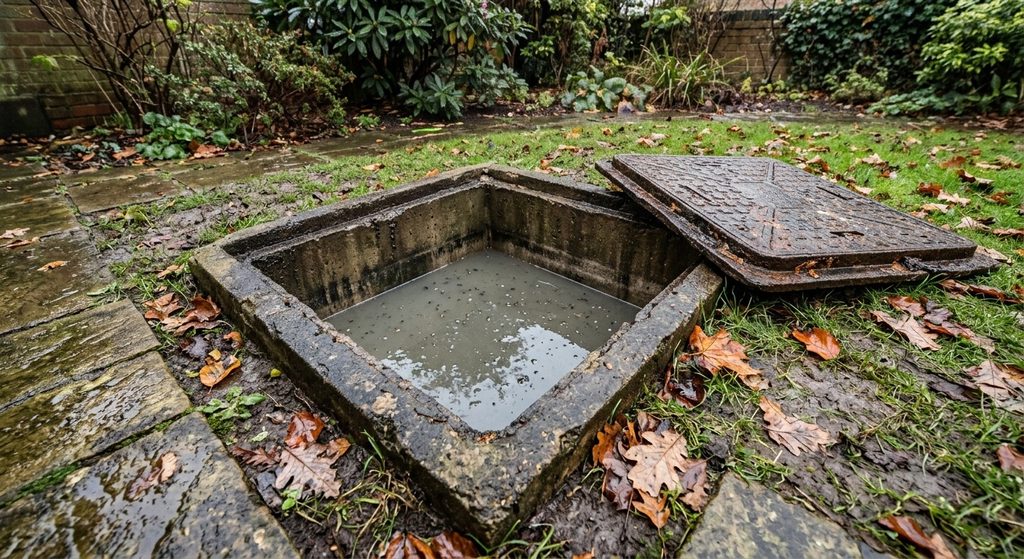
Start at the inspection chamber nearest the house and look at the water level. An empty chamber means the blockage sits between that chamber and the house.
A chamber full to the rim means the blockage is downstream of it, so move to the next chamber along the run towards the boundary and check that one.
- Lift the cover on the chamber closest to the house.
- If it is empty, the blocked section runs back towards the property, so rod from there.
- If it is full, move to the next chamber along and lift it.
- Keep going until you find the first empty chamber. The blocked section lies between that one and the last full chamber.
- If every chamber, including the last one at the boundary, is full, the blockage is at your connection to the public sewer or beyond it.
Not sure which direction the run flows? Run a tap or a hose into a gully and watch which chamber backs up first. On a rural property with a septic tank or bio-cycle unit, a full final chamber often means the tank itself needs emptying rather than the pipe needing rodding.
How to Unblock an Outside Drain Step by Step
Work from the empty chamber towards the blockage with a plunger head fitted, adding one rod at a time and turning them clockwise as you push. Once flow returns, flush the run with a hose for several minutes to carry the loosened debris through.
1. Clearing a Blocked Gully or Yard Drain
Lift the grate, scoop out the leaves, silt and grease sitting in the gully pot, then flush it with the hose. Gullies outside kitchens and under downpipes block at the trap far more often than the underground pipe does, so this is worth five minutes before you assemble any rods.
If water still backs up in a clean gully pot, the blockage is past the trap and the rods come out.
2. Clearing a Blocked Pipe Run With Drain Rods
Rod from the empty chamber, aiming into the mouth of the pipe that heads towards the full one. The same method works for any external drain run, from a kitchen gully to the chamber at your boundary.
- Screw two rods together and fit the plunger head.
- Feed them into the pipe mouth, turning the rods clockwise the whole time. Anti-clockwise unscrews them and leaves a rod stuck underground.
- Add rods one at a time as you push further along the run.
- When you meet resistance, push and pull in short strokes rather than forcing it. Swap to the corkscrew head if the plunger will not break it up.
- Stand back when it goes. The chamber will drain quickly and the water level drops.
- Flush with the hose, then run taps and flush a toilet to confirm the whole run is moving freely.
If the rods reach the blockage and it will not break up after a few attempts, that is usually the point to hand it over to a drain unblocking service rather than keep pushing at it.
5 Mistakes That Make a Blocked Outside Drain Worse

Chemical drain cleaner is the first mistake, because caustic products sit in the standing water of a blocked outside drain and do nothing to wipes, silt or tree roots. They also leave a burn risk for whoever puts their hands in next.
- Turning the rods anti-clockwise, which unscrews them and adds a rod to the blockage
- Forcing a domestic pressure washer into the pipe. That is not the same thing as professional high pressure jetting, and it can open up a crack in an old clay pipe
- Clearing the same blockage three or four times a year without ever finding the cause
- Digging in the garden to reach a pipe whose route you are guessing at
- Pouring boiling water down a plastic gully in the hope of melting grease, which mostly pushes the fat further along to cool and set again
Who Is Responsible for a Blocked Drain in Ireland
You are responsible for the drains inside your property boundary and for the connection running from your house out to the public sewer. Uisce Éireann maintains the public sewer itself, not your connection to it.
Drains shared by several houses are the joint responsibility of every property connected to them, which is why a blockage in a back-garden run usually needs the neighbours involved. Uisce Éireann’s guidance on blockages and pipe responsibility sets out where the line falls, and it will triage a report if you are unsure which side the problem sits on.
| Where the blockage is | Who clears it | Who to contact |
| Inside the house or within your boundary | Property owner | Private drainage contractor |
| Connection pipe from the house to the public sewer | Property owner | Private drainage contractor |
| Shared drain serving several houses | All properties connected to it | Neighbours, then a contractor between you |
| Public sewer in the road | Uisce Éireann | Uisce Éireann |
| Septic tank or bio-cycle system | Property owner | Drainage or tanker contractor |
When to Call a Professional Drainage Contractor

Call a drainage contractor once the blockage will not move with rods, return within a few weeks, or show up as sewage backing into the house. Those three signs point to something structural rather than a soft blockage, and more rodding will not fix any of them.
- Sewage or wastewater rising through a ground-floor shower, toilet or gully
- Several fixtures gurgling or draining slowly at the same time
- The chamber at your boundary overflowing while the ones nearer the house stay clear
- A smell from the drains with no visible blockage anywhere in the run
- Repeat blockages in the same spot, especially near mature trees or hedging
- Ground sinking or a wet patch appearing above the line of the pipe
What a contractor brings is diagnosis, not just clearing. A CCTV camera survey shows the inside of the pipe on screen, so root ingress, a collapsed section, a displaced joint or a belly holding water gets identified instead of guessed at.
How to Stop an Outside Drain Blocking Again
Keep fats, wipes and garden debris out of the system and most blockages never form in the first place. Uisce Éireann clears roughly 10,000 blockages a year from the public network, and the same handful of items cause the ones in private drains too.
If the water is still standing after rodding, or it backs up again a fortnight later, the cause is under the ground rather than in the trap. Request a callout and have the run put on camera before it turns into an excavation job.
