 Skip to content

Septic tank emptying in Ireland costs roughly €230 to €380 for a standard domestic pump-out, and most tanks need doing every one to three years. Access, tank size and how far the tanker has to park move that figure more than anything else.
For most rural homeowners the tank only comes to mind when something changes. Drains slow down, a smell drifts across the garden on a warm day, or a solicitor asks for paperwork during a sale.
How Much Does Septic Tank Emptying Cost in Ireland?
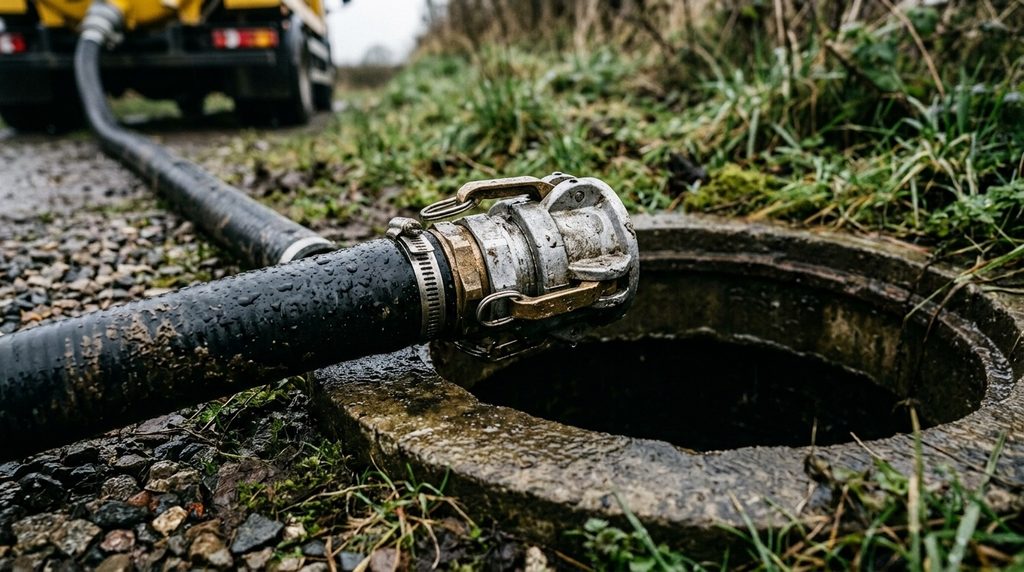
A standard domestic pump-out costs roughly €230 to €380. That covers the call-out, the vacuum tanker, the crew’s time and licensed disposal of the sludge at an authorised facility.
Published ranges from Irish drainage contractors cluster in two bands. Around €230 to €280 for a straightforward job with good access, and €280 to €380 where the tank is larger, access is tighter or the area is dearer. Dublin and the surrounding counties usually sit at the upper end of that spread.
| Job | Typical price range | What it covers |
| Standard domestic tank, good access | €230 to €300 | Call-out, tanker, labour, licensed disposal |
| Larger tank, or Dublin and east coast rates | €280 to €380 | Same work at higher regional and disposal costs |
| Commercial or oversized tank | €300 to €400 and up | Greater volume, longer time on site |
| Difficult access or long hose run | Add €50 to €100 | Extra distance from hard standing |
| Out of hours or urgent call-out | Add €50 to €100 | Evening, weekend or same-day response |
Treat these as market estimates rather than fixed prices. The only reliable number is a quote given once someone knows your tank size, your access and whether the drains are already backing up.
What Changes the Price of a Septic Tank Pump-Out?
Access is the biggest single swing factor. A tanker that can reverse to within a few metres of the covers is a short, cheap job. One that needs a hundred metres of hose dragged across a lawn is not.
- Access and distance. Every extra length of hose adds time, and some sites need a smaller truck or a second visit.
- Tank size and sludge volume. A tank serving a large household holds more, and disposal is charged on what comes out.
- System type. A bio-cycle or packaged treatment plant usually costs more than a traditional tank, because the mechanical parts need checking as well as emptying.
- Condition of the drains. If the inlet or outlet is blocked, clearing it is separate work and adds to the bill.
- Timing. Urgent, evening and weekend call-outs carry a surcharge with most contractors.
The price to empty a septic tank also shifts with fuel and disposal gate fees, which is why a quote from two years ago is rarely the quote you’ll get now.
How Often Should a Septic Tank Be Emptied in Ireland?
Most Irish households need a pump-out every one to three years. Local authority guidance widens that to a one to five year band, because a two-person house and a family of six load the same tank at very different rates.
There’s no national law setting a fixed date for every home. The duty under water services legislation is that your system doesn’t become a risk to health or the environment, and the EPA’s guidance on operating and maintaining septic tank systems sets the practical standard the inspectors work to.
A yearly check is a sensible habit. Lift the covers, look at the sludge and scum build-up, and look at the outflow. If it’s cloudy, smelly or carrying solids, the tank is overdue.
What pulls your own interval shorter:
- More people in the house, or teenagers with long showers
- A smaller or older tank with less settling capacity
- Heavy use of bleach and antibacterial products, which knock back the bacteria doing the work
- Rainwater or surface water finding its way into the system
- Fats, wipes and sanitary items going down the drains
5 Warning Signs Your Septic Tank Needs Emptying Sooner
Don’t wait for the calendar if the system is already telling you. Slow drains across the whole house, rather than one fixture, are the clearest early sign that the tank is full rather than the pipe being blocked.
- Gurgling from sinks, baths or the toilet when water drains elsewhere
- A persistent smell near the tank or over the percolation area
- Grass that’s unusually lush, soft or wet above the percolation trenches
- Standing water or dark liquid ponding on the ground near the system
- Sewage backing up into the lowest fixture in the house
If the smell and the ponding continue right after a pump-out, the problem is downstream of the tank. That’s the point of booking a CCTV camera survey rather than paying for a second emptying, because a collapsed outlet or a choked percolation area won’t fix itself.
What Happens During a Septic Tank Cleaning Visit
A standard visit is a pump-out, not a deep clean. The crew locates and lifts the covers, measures the sludge and scum layers, then empties the tank with a vacuum tanker and takes the waste away for treatment at a licensed facility. Most also check that the outlet is running clear before they leave.
The operator running the tanker services must hold a valid waste collection permit, and you should get a docket or receipt confirming where the waste went. Keep it. That paperwork is exactly what an inspector asks to see.
You can check whether a contractor is permitted on the National Waste Collection Permit Office register before you book, which takes a minute and rules out anyone tipping sludge into the nearest ditch.
- Covers located and opened
- Sludge and scum levels checked
- Tank emptied by vacuum tanker
- Baffles and outlet checked for flow
- Waste transported to an authorised facility
- Docket issued for your records
Does the Septic Tank Grant Cover Emptying Costs?
No. The septic tank grant covers repair, upgrade or replacement of a failed system, not routine servicing. Citizens Information states plainly that you cannot get a grant for the routine maintenance, servicing or de-sludging of a treatment system.
What the grant does cover is remediation after an inspection failure. Funding is available for 85% of the cost of repairs or a new system, up to a maximum of €12,000, and the criteria changed on 1 January 2024 so households that hadn’t registered by 1 February 2013 can now qualify.
Details of the septic tank grant schemes and how to apply sit with your local authority’s rural water section. Put another way, the €250 you skip this year isn’t grant-aided, and neither is the reason you’ll need the grant later.
What Septic Tank Inspections Mean for Homeowners in Fingal and North Dublin

Inspection failure rates are high and getting worse. Local authorities completed 1,466 septic tank inspections in 2025 and 59% of them failed because the systems were not built or maintained properly. Many of those failures come down to maintenance rather than structural faults.
There’s a local angle worth knowing. The EPA’s 2026 report notes that three local authorities, Donegal, Fingal and Wexford, fell short of their inspection targets in 2025 and must make up that shortfall during 2026 on top of planned inspections.
For anyone with a tank in the Fingal, north Dublin or Meath border area, the odds of a letter arriving this year are higher than usual.
If your system is inspected, have three things to hand:
- Your registration certificate from the national register
- Any paperwork from the original installation
- Recent desludging dockets showing the tank has been emptied and by whom
Fail, and the council issues an advisory notice setting out the works and a deadline. Pass, and you get a certificate confirming the system meets the standard.
How to Stretch the Time Between Septic Tank Pump-Outs
Reducing what enters the tank is the only reliable way to lengthen the interval. Solids and fats are what build the sludge layer, and everything that goes in has to be pumped back out eventually.
- Keep wipes, nappies, sanitary items and cat litter out of the toilet, including anything sold as flushable
- Scrape fats and cooking oil into the bin instead of the sink
- Fix a leaking cistern or dripping tap, which quietly floods the tank with clean water
- Divert gutters and surface water away from the system
- Spread laundry loads across the week rather than running six on a Saturday
- Go easy on bleach and antibacterial cleaners
- Keep covers accessible so a check costs you nothing but ten minutes
Tank additives are widely sold and widely oversold. None of them remove sludge, and a tank that’s full still needs a tanker.
Booking a Septic Tank Emptying Without Guesswork
A pump-out every year or two is one of the cheapest pieces of property maintenance you’ll ever pay for, and it’s the difference between a €250 visit and a percolation area that needs digging up. Rural households across north Dublin, Fingal, Meath and Louth are on that cycle already.
If you’re not sure when the tank was last emptied, or the drains have started running slow, request a quote and get a firm price for your tank, your access and your site.
