 Skip to content


A sewer smell in the house means foul air from the drainage system is getting into a room instead of venting safely above the roof. The most common cause is a water trap that has dried out or lost its seal, though a blocked vent pipe, a failed toilet seal or a cracked underground drain will do exactly the same thing.
Some of these take two minutes and a jug of water. Others sit under the floor or outside the back wall, and no amount of bleach will shift them. Knowing which one you have saves a wasted evening and a lot of guessing.
Below is what the smell actually is, how to narrow the cause down by where and when you notice it, and what fixing each one involves.
What Causes a Sewer Smell in the House?
Sewer odour reaches a room whenever the barrier between the house and the drainage system fails. Every sink, bath, shower and toilet sits above a water trap, and the small plug of water held in that bend is the seal.
Break the seal, crack the pipe behind it, or block the vent that balances pressure in the system, and foul air comes straight back up through the plughole.
Irish building regulations treat that water seal as the first line of defence. Technical Guidance Document H requires every discharge point to be fitted with a trap so foul air cannot enter the building, and traps must retain a minimum 25mm seal under working conditions.
Sinks, baths, basins and showers are given 75mm seals and WC pans 50mm. That is why a bathroom left unused for a few weeks starts to smell before anything else in the house does.
Most household sewer odours trace back to one of these:
- Dried-out traps in unused sinks, showers or floor gullies
- Damaged or loose seals at the back of a WC pan or a waste pipe joint
- Blocked soil vent pipes or failed air admittance valves, which siphon traps dry
- Cracked, sunken or root-damaged underground drains
- Blocked gullies outside kitchen and bathroom walls
- Fat, grease and food debris rotting inside a waste pipe
- Septic tanks or bio-cycle units overdue a service
Where You Smell the Sewer Odour Points to the Cause
Where the smell is strongest, and when it shows up, narrows the cause down faster than anything else. A smell confined to one spare bathroom is a very different problem from a cold, sewery draught drifting through the whole ground floor.
| Where and when you notice it | Most likely cause | What usually fixes it |
| One rarely used bathroom or utility room | Dried-out trap or floor gully | Run the taps and flush for a few minutes |
| Around the base of a toilet, worse after flushing | Failed pan connector or seal | Reseal or replace the connector |
| Whole house, worse on windy or wet days | Blocked soil vent pipe or failed air admittance valve | Clear or replace the vent |
| Kitchen sink only, sour or greasy | Fat and food build-up in the waste pipe | Degrease and jet the line |
| Ground floor, faint and cold, comes and goes | Cracked or collapsed underground drain | CCTV survey, then patch, reline or dig |
| Outside near the back wall, drifting in a window | Blocked back inlet gully | Clear the gully and check the grating |
| Rural home, worse in warm still weather | Septic tank or bio-cycle unit needing service | Desludge and service the system |
Timing matters as much as location. Odour that worsens on windy or wet days points at the vent stack, because changing pressure outside pushes air back down a system that cannot breathe properly.
3 Quick Fixes for a Sewer Smell You Can Try Yourself
Three of the most common causes are homeowner fixes and none of them needs tools. Refill dried traps, clear the build-up inside a waste pipe, and check that outside gullies are running clear.
If the smell has gone within a day, that was your cause.
1. Refilling a Dried-Out Trap or Gully
Run every tap, shower and flush in the affected room for a couple of minutes, then check again an hour later. Evaporation empties a trap in a matter of weeks, which is why spare bathrooms, utility room floor gullies and holiday homes are the usual offenders.
Set a reminder to run those outlets once a month and the problem never comes back.
2. Clearing Build-Up in a Kitchen or Bathroom Waste Pipe
A sour or greasy smell at a single plughole is usually a film of fat, soap and food debris coating the inside of the waste pipe. The water is still sealing the trap. The smell is coming from the pipe wall above it.
- Lift and clean the plughole grate and the shower hair trap
- Flush with hot water rather than boiling water, which can distort plastic waste pipes
- Follow with bicarbonate of soda and white vinegar, leave it to sit, then rinse
- Skip caustic cleaners, which are built to punch through blockages, not remove a coating
Checking Outside Gullies and Grates for Debris
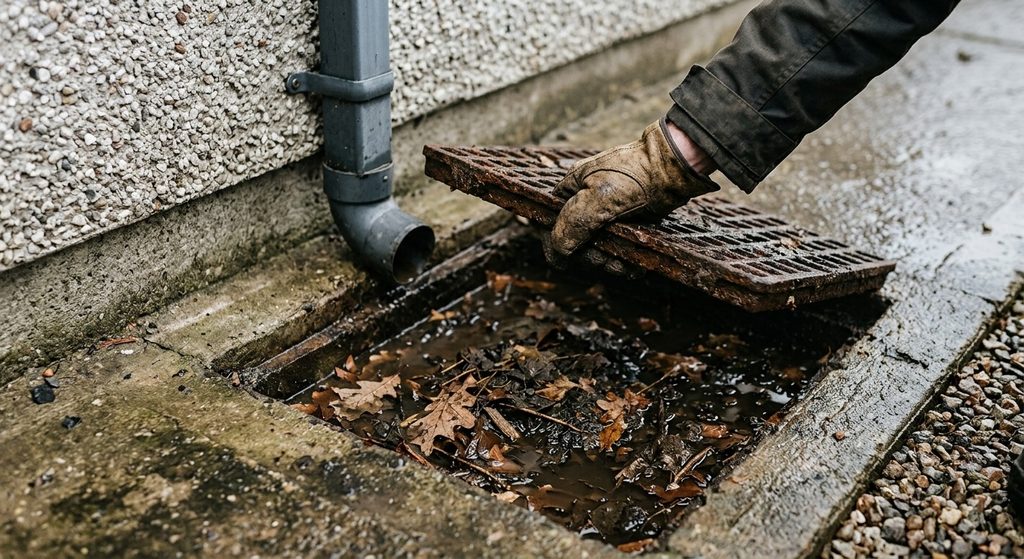
Step outside and look at the gully below the kitchen or bathroom waste pipe. If it is choked with leaves, silt or congealed grease, wastewater sits on top instead of dropping through the trap underneath, and the odour drifts back in through the nearest window.
Lift the grate, clear it by hand and run the taps to see if it drains cleanly. A gully that still fills and empties slowly has a blockage further down the line, and a proper drain unblocking at the right point is what stops the smell returning for good.
4 Sewer Smell Causes That Need a Drainage Professional
If the smell survives a day of flushing and clearing, the fault is in the pipework rather than the water sitting in it. Failed seals, blocked vents and damaged underground drains leak sewer gas continuously, and all three get worse the longer they are left.
1. Failed Toilet Seals and Pan Connectors
Odour around the base of a WC, strongest just after a flush, points at the pan connector or the seal where the toilet meets the soil pipe. Rubber connectors harden and shrink with age, and a toilet that has been rocked or refitted often never seats properly again.
Staining on the floor or loose fixing bolts usually show up before the smell does.
2. Blocked Soil Vent Pipes and Failed Air Admittance Valves
Blocked vents are the cause people miss, because the smell appears nowhere near the fault. The soil vent pipe lets air into the system as water drains away.
Block it with a bird’s nest, leaves or frost, and draining water pulls the water out of your traps instead, opening every one of them at once. Gurgling from a sink when the toilet flushes is the classic warning. Air admittance valves fitted in a loft or under a sink do the same job and fail the same way, usually by sticking open.
3. Cracked or Collapsed Underground Drains
A cracked, sunken or root-damaged drain leaks sewer gas into the ground beneath the house, and it works up through floor voids, service penetrations and gaps around pipework. The smell tends to be faint, cold and hard to place.
You cannot diagnose this from inside. A CCTV drain survey run from the nearest chamber shows the fractured joint, the root ingress or the dip holding standing water, and it shows how far along the run the fault sits.
Damaged pipes are also how rats find their way into a drainage system, so a foul smell paired with scratching in the walls is worth investigating properly.
4. Septic Tank and Bio-Cycle Odour in Rural Homes
On a property with its own treatment system, a persistent smell usually means the tank is overdue or the unit has stopped working as it should. Warm, still weather makes it obvious first.
- Wet, dark patches or unusually lush grass over the percolation area
- Slow drainage indoors with no blockage at the fixtures
- Odour strongest in the garden rather than inside the house
Uisce Éireann sets out who is responsible for clearing blockages, and septic tanks fall outside its remit, as does the private drain running from your house to the public sewer.
Is Sewer Gas in the House Dangerous?
Sewer gas is a mix of methane, hydrogen sulphide, carbon dioxide and ammonia given off as waste breaks down. At the levels found in a home it is usually a nuisance rather than an immediate danger, although ongoing exposure is linked to headaches, nausea and eye or throat irritation.
Treat it as urgent rather than annoying if any of these apply:
- Sewage or wastewater is backing up into a sink, bath or toilet
- The smell hits you the moment you walk in the door
- Someone in the house has headaches or breathing trouble that eases when they leave
- The odour is in a cellar, basement or other enclosed space with little ventilation
Methane is flammable, which is why enclosed spaces matter more than an airy hallway. Open the windows, ventilate the room and get the source found rather than masked.
How Drainage Specialists Trace a Sewer Smell

Tracing an odour is elimination work that runs from the fixtures outwards. A methodical odour investigation rules out the simple causes first, then puts the system under test conditions so the leak reveals itself instead of being guessed at.
- Check every trap, gully and appliance connection for a lost or broken seal
- Test the soil vent pipe and any air admittance valves for blockage or failure
- Run a CCTV camera through the drain runs to find cracks, displaced joints, root ingress and standing water
- Use electronic pipe tracing to mark the exact position and depth of the fault
- Pressure or smoke test pipework hidden in a wall or under a floor
- Repair by patching or re-lining where possible, and excavate only where a no-dig fix will not hold
Pinpointing the fault is what keeps the repair small. A located crack can often be patched or re-lined from inside the pipe, with no digging and no damage to a drive or a finished floor.
How to Stop Sewer Smells Coming Back
Most repeat odours come from two habits, which are letting traps dry out and putting things down the drain that were never meant to go there. Both are cheap to change compared with a second call-out.
- Run the taps and flush the toilet in spare bathrooms at least once a month
- Pour fats, oils and cooking grease into a container and bin them once cool
- Bin wipes, cotton buds, floss and sanitary items, whatever the packaging claims about being flushable
- Clear leaves and silt out of external gullies every autumn
- Fit and service a grease trap if you run a commercial kitchen
- Book planned maintenance if the same drain blocks more than once a year
Getting a Sewer Smell Sorted Before It Gets Worse
Sewer smells rarely fix themselves. A dried trap refills and the problem disappears, but a blocked vent, a failed seal or a fractured underground pipe only leaks more as time passes, and the repair gets bigger with it.
If you have run the taps, cleared the gullies and the smell is still there, the next step is a proper diagnosis instead of another bottle of cleaner. Request a callout and have the source traced, mapped and fixed the first time.


